Google Changed the Search Box. The One That Hasn't Changed Since 2001.
For 25 years, the way you used Google was exactly the same. You typed a few keywords into a white rectangle, hit enter, and got a list of blue links. That was it. The interface barely changed, the habit barely changed, and billions of people built their entire relationship with the internet around that single interaction.
On May 19, 2026, at its annual Google I/O developer conference, Google formally retired that paradigm.
The company announced what it called — in the words of Liz Reid, Google's VP and Head of Search — "the biggest upgrade to our iconic search box since its debut over 25 years ago." The search box now accepts text, images, files, videos, and even open Chrome tabs as inputs simultaneously. It expands as you type to accommodate longer, more conversational queries. It offers AI-powered suggestions that go well beyond the old autocomplete. And the results it delivers are no longer just a list of links — they're synthesised AI answers, with traditional results sitting alongside them.
If you run a business in India and you've been hearing about AI changing everything for the past two years, this is the announcement that makes it concrete. Here's what actually changed, and what it means for you.
What Google Actually Announced
There are a few distinct things bundled into what Google announced at I/O 2026. It's worth separating them because they matter differently.
The Intelligent Search Box
Google transformed the search box from a simple keyword input into a dynamic, AI-driven conversation starter that can accept text, images, PDFs, videos, and even open Chrome tabs as inputs. The box itself expands as you type — you're no longer constrained to typing "dentist Jalgaon" and hoping Google figures out what you mean. You can type a full paragraph describing your situation and Google will process it.
The AI suggestions that appear as you type are described as going beyond autocomplete — they're anticipating the full intent behind your query, not just the next word.
AI Overviews and AI Mode Are Now One Thing
Previously, Google had two separate experiences — the standard search results page with AI Overviews (those AI-generated summaries at the top), and AI Mode, a separate conversational interface. Google merged its AI Overviews and AI Mode features into a single, seamless search flow, eliminating the friction that previously forced users to choose between a traditional results page and an AI-forward experience.
What this means practically: a user can now search something, get an AI summary alongside traditional results, and immediately continue into a back-and-forth conversation about it — without going anywhere else.
Search Agents
This is the genuinely new thing. Google has also introduced information agents — ongoing AI systems that track topics continuously without needing to be prompted. You can tell Google to monitor something — new apartment listings matching your criteria, news about a specific topic, price changes for a product — and it will push notifications to you without you having to search again.
For businesses, this has implications that aren't fully clear yet. It means Google can track what's happening in a market and surface relevant businesses proactively to users who have shown interest in that category.
The scale of adoption: AI Mode has surpassed one billion monthly users in its first year, with queries doubling every quarter since launch. This isn't a beta experiment — it's the main product now.
What This Changes for How People Search
The behavioural shift is real and it's already happening. AI Mode search queries are almost three times longer than conventional Google searches, indicating a significant change in user behaviour.
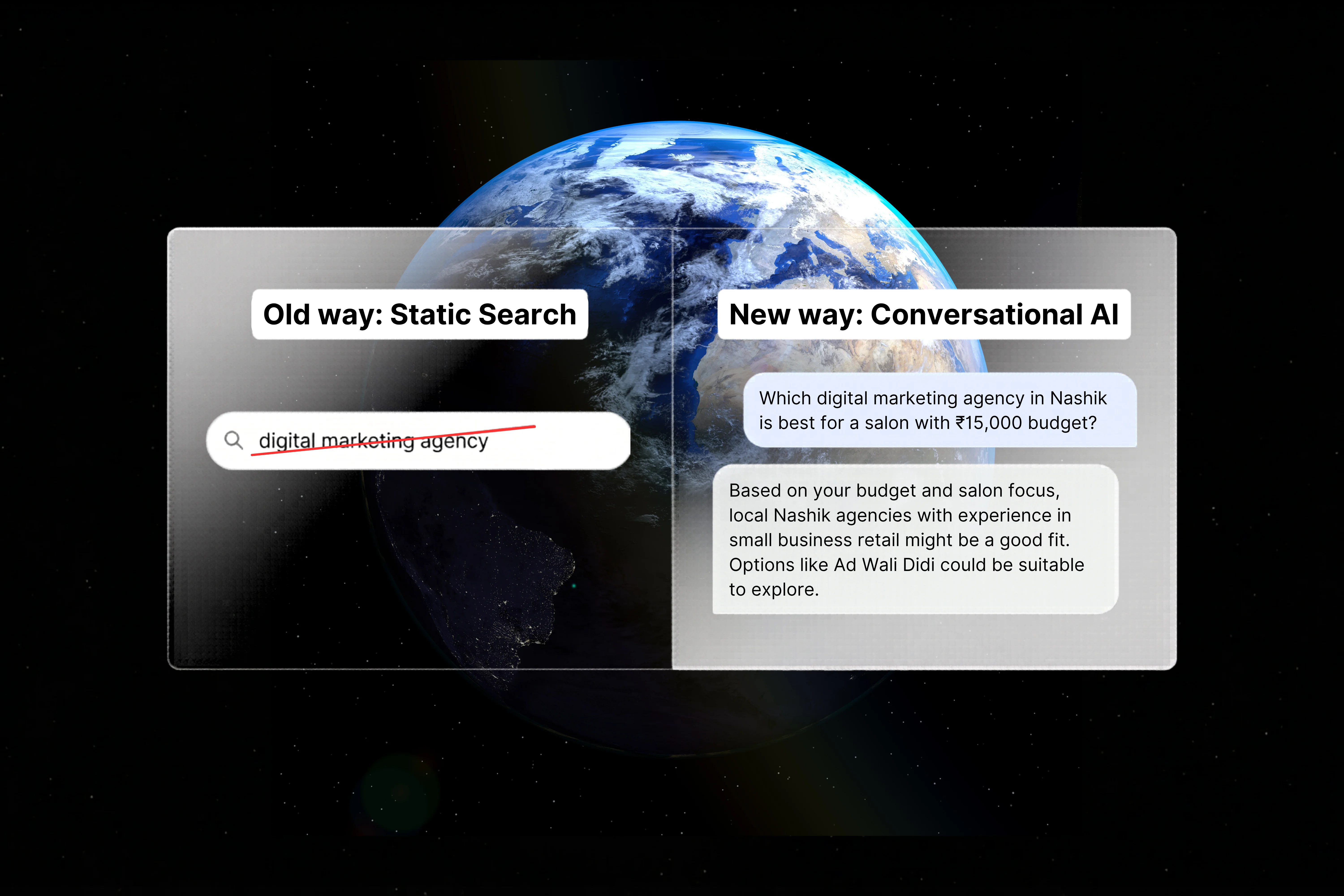
People are no longer typing "digital marketing agency Nashik." They're typing "I run a salon in Nashik with a monthly budget of ₹15,000, which platforms should I advertise on and what results should I expect?" That's a fundamentally different query — and Google's AI is answering it directly, synthesising information from multiple sources, without necessarily sending the user to any specific website.
The old-school SEO methodology, which concentrated on optimising for short, rigid keywords, is becoming more obsolete. Search enquiries are becoming longer and more contextual. The content that will win will need to answer complex, multi-dimensional human situations, not just simple keyword matches.
This is not speculation anymore. It's what the data shows.
The Part Nobody Is Saying Loudly Enough
Here's the uncomfortable truth about what Google's AI search means for the broader internet — and why you should understand it.
Data showed that Google referral traffic for 2,500 publisher sites fell by 33 per cent year-over-year in 2025. DMG Media reported traffic drops of nearly 90 per cent for certain search categories. When Google's AI answers a question directly in the search results, a large portion of users never click through to any website. They got their answer. They leave.
If your Google Search Console data shows impressions rising while clicks and CTR fall, you are already seeing the effect. AI Overviews and AI Mode are absorbing the traffic that used to reach your pages.
For large content publishers, this is a serious problem. For local service businesses in Jalgaon, Nashik, or Indore — it's a much more nuanced picture.
What This Actually Means for a Small Business in India
This is the part most articles skip because they're writing for a global audience of tech marketers. Let's be specific about what this means if you run a local service business in a Tier 2 or Tier 3 Indian city.
Your Google Business Profile just became more important, not less
When someone searches "clinic near me" or "best salon in Nashik," Google's AI doesn't just read blog posts to answer that — it pulls from Google Business Profiles, reviews, location data, and structured business information. Local and shopping optimisation through Google Business Profiles directly influences what appears in AI responses.
A well-maintained GBP — complete information, regular photos, genuine reviews, updated hours — is now feeding directly into what Google's AI tells users about your business. If your GBP is incomplete or has outdated information, the AI may describe your business inaccurately or not surface it at all.
Content that answers real questions still wins
Google's own guidance released alongside these changes is clear: unique, non-commodity content that reflects genuine expertise, original research, or first-hand experience earns inclusion in AI responses. Generic summaries that AI can generate itself add no citation value.
This is exactly why the blogs we write for Ad Wali Didi are structured the way they are — specific to Jalgaon's jewellery market, specific to Nashik's winery tourism, specific to real budget numbers in real Indian cities. Generic "here are 5 digital marketing tips" content was already weak SEO. In the AI search era, it's worthless. Content with genuine, specific, first-hand perspective is what gets cited.
Paid Ads are completely unaffected
It's worth being direct about this: everything happening with organic search and AI Overviews does not touch Google Ads. Paid search placements still appear. The auction still runs. If you're running Google Ads for your business, nothing about I/O 2026 changes how those ads work or appear.
For businesses that were relying primarily on organic search traffic, this is a reason to look seriously at paid ads as a more stable acquisition channel — the organic traffic landscape is becoming less predictable. For businesses already running paid ads correctly, stay the course.
Voice search is growing fast in Tier 2 cities
One India-specific data point worth flagging: over 58% of searches in Tier 2 and Tier 3 cities are now voice-based, primarily in Hindi, Tamil, Telugu, and Bengali. As Google's AI search becomes more conversational, the gap between voice search and typed search narrows. A business owner in Dhule asking their phone "achha digital marketing agency near me kaun si hai" is now getting an AI-synthesised answer, not just a list of links.
This makes your GBP and review presence in Hindi and regional languages increasingly relevant — not just English.
What You Should Actually Do About This
Skip the panic. Here's the practical list:
Audit your Google Business Profile this week. Every field filled in, photos updated in the last 3 months, hours accurate, services listed specifically. This feeds directly into AI search results for local queries.
Keep publishing specific, useful content. The blogs you're reading on this site are written with first-hand perspective and India-specific data — exactly what Google's AI cites and surfaces. Generic content will disappear from AI results. Specific, expert content will get more visibility, not less.
Don't change your paid ads strategy based on this. The organic search landscape is shifting. Paid ads are stable. If anything, the argument for having a paid ads budget alongside organic SEO just got stronger — organic is less predictable now than it was two years ago.
Ask questions in your content that match how people actually talk. Someone in Nashik asking about salon marketing isn't typing "salon marketing Nashik." They might be asking "how do I get more customers for my salon in Nashik without spending too much?" Write for that question, not the keyword.
The core of good digital marketing hasn't changed. Be findable, be credible, be specific. What's changed is the surface those qualities need to show up on. Google just made that surface significantly bigger.
Not sure how these changes affect your business's visibility on Google?
We stay on top of this so you don't have to. WhatsApp us for a straight answer about where your business stands.
WhatsApp Us